



Every Monday, an identical ritual unfolds in marketing meetings across countless e-commerce companies. Colorful charts light up the screens, and the room fills with a mix of emotions: from pride when the bars trend upward, to a frantic scramble for explanations when they take a dive.
We are talking about the metrics that have defined the success of broader email marketing for years: Open Rate (OR), Click-Through Rate (CTR), and a low Unsubscribe Rate. Regardless of the mood in the room, this traditional “holy trinity” of KPIs continues to dominate the conversation. But do they actually translate into what matters most—real revenue and bottom-line profit? What if the true heroes should be metrics like transaction volume, revenue, and Average Order Value (AOV)?
To answer this question, I dove deep into the data of one of our clients. I analyzed nearly five years (January 2021 – August 2025) of email marketing campaigns for a large e-commerce store. Having direct access to such an extensive dataset allowed me to verify what genuinely drives sales. And frankly, the results caught me by surprise.
My use of the term "holy trinity" to describe OR, CTR, and Unsubscribe Rate in this article is entirely intentional. Let me explain why. This phrase refers to the most traditional, legacy metrics that email marketing specialists have focused on for years. These indicators reflect the health of the campaign itself and the mailing list, but don't necessarily show how they translate into actual revenue.

🟣 OR (Open Rate): was the email opened? (evaluates subject line and preheader effectiveness).

🟣 CTR: did anyone click the link? (assesses the effectiveness of the creative, copy, and CTA).

🟣 Unsubscribe Rate: are we annoying people? (measures list hygiene and health).

This "old holy trinity" of email-centric metrics fails to capture the full picture of a campaign's effectiveness. The true business value lies in metrics such as transactions, revenue, and AOV.
Methodology and data
I analyzed aggregated monthly data spanning from January 2021 to August 2025, tracking the following variables:
- Number of emails sent,
- Open Rate (OR),
- Click-Through Rate (CTR),
- Number of unsubscribes,
- Number of transactions,
- Monthly campaign revenue,
- Average Order Value (AOV).
The primary analytical tool used was Pearson’s correlation coefficient. Without diving too deep into the technicalities, this is a statistical measure that quantifies the strength and direction of the relationship between two variables. A coefficient close to 1 indicates a strong positive correlation (as X increases, Y also increases). A value close to -1 indicates a strong negative correlation (as X increases, Y decreases). A result near 0 suggests no linear relationship.
What did the numbers reveal?
Oto profesjonalne tłumaczenie kolejnego fragmentu, które zachowuje dynamiczny, wręcz publicystyczny styl oryginału przy jednoczesnym zachowaniu biznesowej precyzji:
Surprise #1: transaction volume—a good promotion beats engagement every time
An analysis of transaction volume across different years yielded interesting insights into evolving consumer behavior.
-
2021–2022: things were straightforward, aligning with common assumptions. The more emails sent, the more transactions generated. The correlation between send volume and transaction count hovered around 0.9.
-
2023–2024: something began to break down. Send volume alone lost its impact. What’s more, I observed a growing negative correlation between OR/CTR and transactions.
-
The first 8 months of 2025: this year brought yet another twist—like a good thriller. The correlation between send volume and transactions bounced back to a record high of 0.94, but at the same time, OR and CTR metrics were strongly negatively correlated with sales.
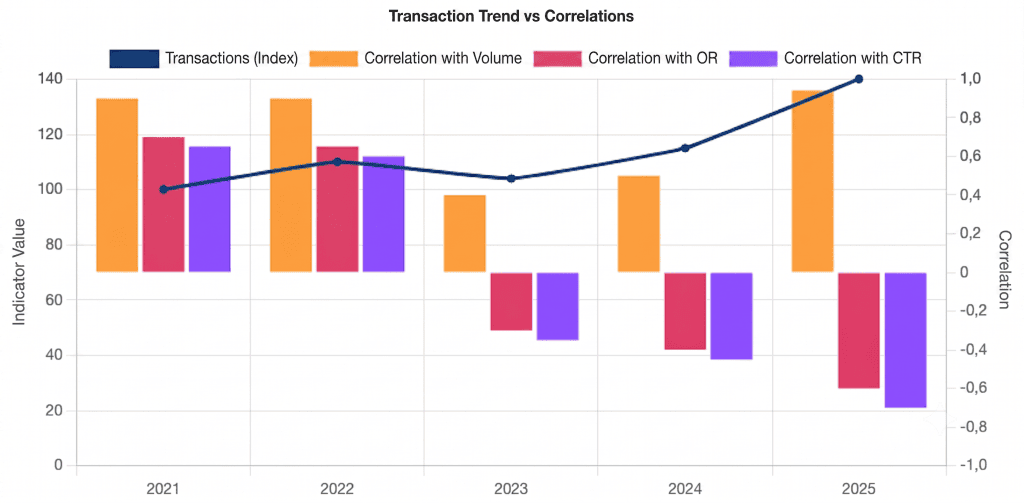
Takeaway: initially, transaction volume grew in tandem with the number of emails sent. Over time, however, this relationship weakened. By 2025, despite a record-high correlation with send volume, OR and CTR metrics showed a significant negative correlation. This proves that sales are driven by the timing and substance of the promotion, rather than mere email engagement.
🟣 As the channel with the highest degree of personalization, email marketing supports #AccountBasedMarketing strategies, enabling the deployment of hyper-targeted sequences to specific decision-makers within selected organizations. Dynamic content (such as product recommendations or industry-specific case studies) combined with data-driven triggers helps build relationships and measure the real impact on overall campaign performance.

🟣 Regular thought-leadership newsletters, educational series, and "behind-the-scenes" content strengthen brand image and credibility, driving #brandbuilding efforts. Through consistent branding, high-quality copy, and regular send cadences, email marketing fosters top-of-mind awareness among both customers and business partners.

🟣 Email marketing also drives sales within the #anywherecommerce model—"anywhere, anytime." Instant triggers based on user behavior on-site or within an email (such as abandoned carts or abandoned browse sessions) initiate highly relevant messaging, streamlining the path to purchase regardless of where the user interacts with the platform.
Surprise #2: AOV—the unsung hero of profitability
When analyzing AOV, I decided to replace actual monetary values with an indexed Average Order Value metric (iAOV). Let’s assume that the baseline average for 2021–2022 represents 100 points.
-
2021–2022: AOV remained stable at a baseline of 100 iAOV.
-
2023–2024: a breakthrough occurred. The Average Order Value surged to 118 iAOV (an 18% increase!). Paradoxically, correlations with OR and CTR were heavily negative.
-
2025: AOV stabilized at a high level of around 114 iAOV. A slight correlation also emerged between high AOV and the unsubscribe rate.
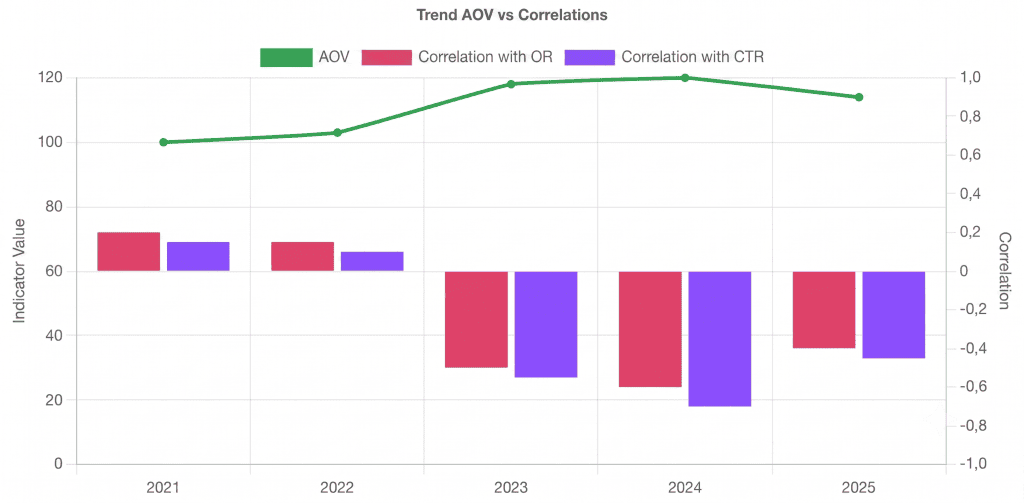
Takeaway: customers are willing to spend more, but they do so less frequently and on their own terms. This presents a massive opportunity to expand bundling, upselling, and cross-selling strategies. Focusing on AOV requires a completely different approach than chasing clicks.
Surprise #3: revenue—where the real focus belongs
Revenue is the product of multiplying transaction volume by AOV. How did this critical metric perform over time?
-
2021–2022: revenue was driven by both high send volumes and solid engagement metrics.
-
2023–2024: the impact of send volume weakened. However, the situation was salvaged by a sharp, sudden jump in AOV.
-
2025: send volume had a record-breaking impact on revenue (a 0.94 correlation), while OR and CTR dropped into negative correlation territory.
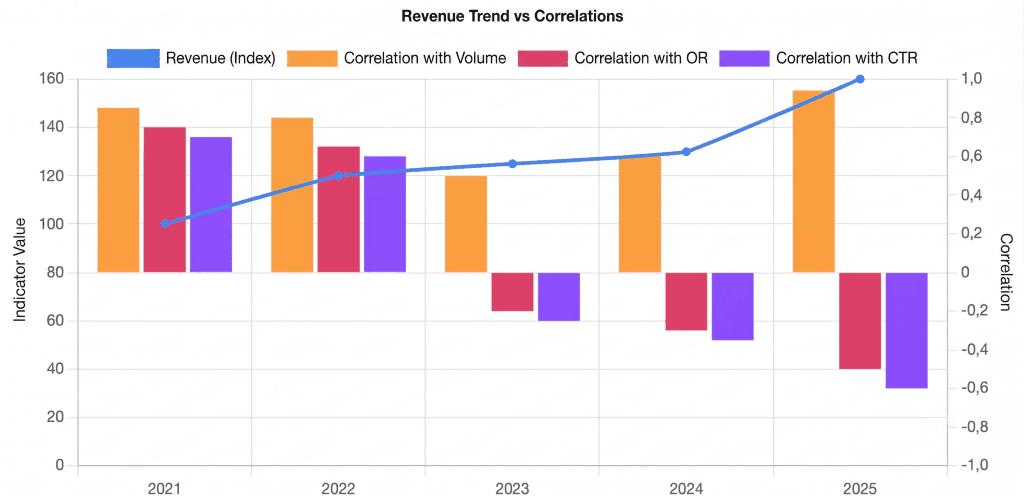
Takeaway: revenue is a function of transactions and AOV. Over the years, it has become clear that combining send scale (volume) with attractive, highly targeted promotions (which drive up AOV) is the key to maximizing profits. In this specific context and for this particular client, OR and CTR metrics proved to be irrelevant.
From vanity metrics to bottom-line profits
I always say that you can’t take Open Rates and Click-Through Rates to the bank. Real revenue is generated by well-thought-out email promotions, a deep understanding of customer needs, and smart strategies aimed at driving up average order value.
So, if the open rate in your next report looks spectacular but sales are slumping—don’t panic. It is simply a sign that it’s time to stop asking, “How many people opened it?” and start asking, “What real value are we offering to make customers actually want to buy from us?“
P.S. The above analysis is based on a specific case study and may not reflect the exact dynamics of your own e-commerce store. Analyze your data over the longest timeframe available to you. Map your monthly revenue, transactions, and AOV alongside your OR, CTR, and send volume in Excel, then calculate the correlations. The insights you uncover might permanently reshape how you view email marketing.
Key Takeaways
- Promotions sell, not ORs. Open Rate (OR) and CTR are not useless, but their role has shifted. Treat them as technical health indicators—they reflect list hygiene and deliverability performance, not business growth. Focus on crafting offers that deliver real value instead of merely optimizing for opens.
- The promotion is the engine, volume is the fuel. An attractive, well-communicated offer is the heart of your sales. Send volume is the energy that allows that engine to run at full throttle.
- Volume matters, and unsubscribes are not the end of the world. Don’t be afraid to send emails, provided you have something compelling to offer. Scale combined with quality works. At the same time, understand why customers leave. An unsubscribe following a major purchase isn’t necessarily a failure—it’s a signal. It might be time to build post-purchase segmentation and workflows to serve them a different type of communication.
- AOV is your hidden growth lever. If customers are willing to spend more, you need to facilitate that behavior. Analyze purchase paths, build smart recommendations, and offer premium packages. Encourage larger orders through bundling, upselling, and cross-selling. This is the most direct route to higher revenue.
- Analyze your own data. Run your own correlations. The real answers are hidden in your unique data, not in generic industry benchmarks.